Articles
Step 1: Learn the Basics
My first step is to learn enough of the basics of RC and UAS technology to start prototyping and testing.
Contents
My first step is to learn enough of the basics of RC and UAS technology to start prototyping and testing. I intend to develop a non-standard aircraft architecture, likely a true mono-copter, so being able to develop custom control algorithms is extremely important. I’ve seen that many R&D or university research projects utilize Teensies. However, the purpose of this project is to have a fully functional heavy lift UAS. And, of course, to compete in DARPA Lift 2028. Given my extremely limited knowledge, that points me towards developing in an established UAS architecture. I ended up deciding on PX4, hopefully UncleChat didn’t steer me wrong.
Autopilot Selection
With the help of UncleChat, I narrowed down the options to PX4 as the place to start with ArduPilot and potentially Paparazzi as an alternative. Hopefully, I don’t have to try all three and end up developing on a Teensy anyway!
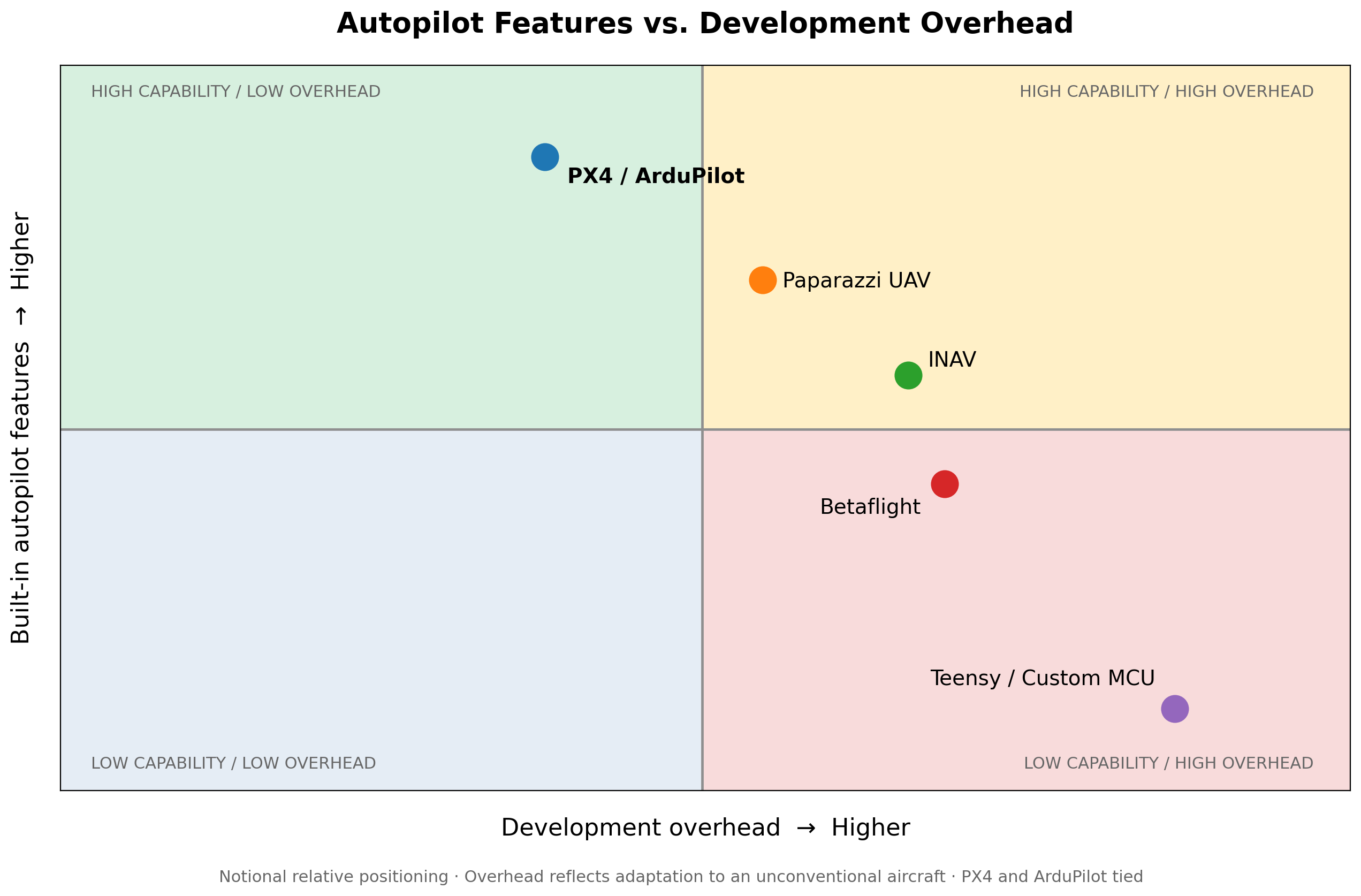
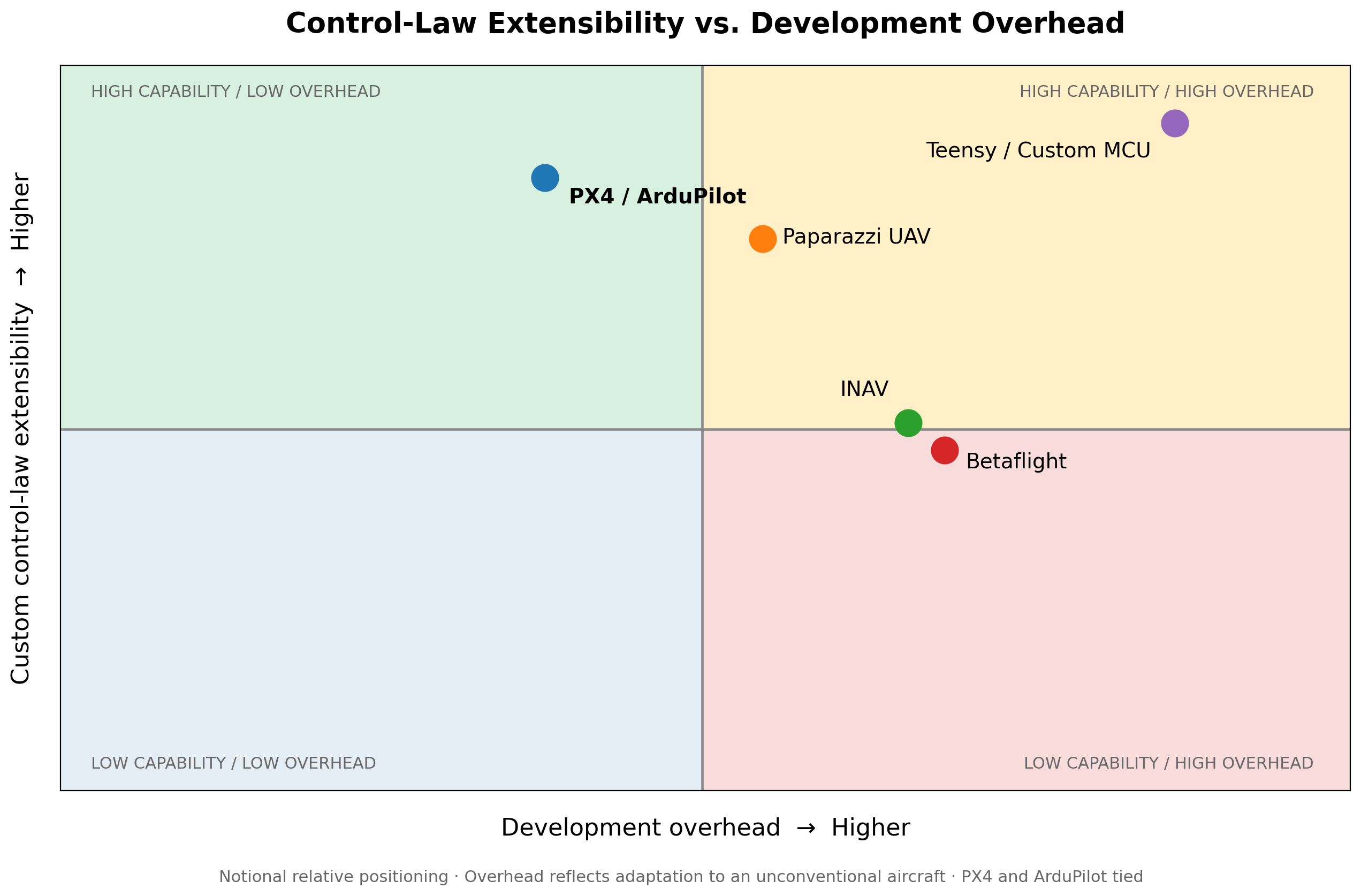
My main concerns are:
- Being able to extend the code for the required custom control laws. Including supporting required latency and hardware.
- Not needing to develop any necessary Autopilot features.
UAS Autopilot Trade-Space Summary
| Evaluation Criteria | PX4 | ArduPilot | INAV | Betaflight | Teensy / Custom MCU | Paparazzi UAV | Crazyflie |
|---|---|---|---|---|---|---|---|
| Custom control algorithms | C++ modules | C++ custom-controller framework | C source modifications | C source modifications | Fully custom C/C++ | Custom C modules | Out-of-tree C controllers |
| Custom actuator mixing | Modular control allocation | Configurable allocation / C++ | Configurable mixers | Configurable mixers | Fully custom | Configurable / custom | Custom firmware integration |
| Flight-mode switching | Built-in; externally extensible | Built-in; controller switching | Built-in modes | Basic modes | Fully custom | Built-in; extensible | Runtime controller selection |
| Control-mode blending | Custom implementation | Custom implementation | Significant modifications | Significant modifications | Fully custom | Custom implementation | Custom implementation |
| Extensibility without recompilation | External ROS 2 modes | Onboard Lua scripting | Configurable logic | Limited configuration | Native programming | Configurable flight plans | Parameters / command interface |
| Custom controller integration | uORB / C++ modules | Dedicated custom-controller framework | Core firmware modifications | Core firmware modifications | Native implementation | Modular C architecture | Out-of-tree controller interface |
| External software integration | ROS 2, MAVLink | MAVLink, companion software | MSP / serial | MSP / serial | Custom protocols | Custom interfaces | Crazyradio / Python ecosystem |
| Maturity | High; widely adopted | Very high; widely adopted | High; established | Very high; FPV focused | Hardware mature | Established research platform | Established research platform |
| Documentation | Extensive developer documentation | Extensive developer documentation | Good configuration docs | Extensive FPV docs | Excellent MCU docs | Research-oriented documentation | Strong research/developer docs |
| Programmable autopilot features | C++, ROS 2, MAVLink | C++, Lua, MAVLink | Programming framework, C | CLI, MSP, C | Fully custom C/C++ | C modules, flight plans | C controllers, parameters |
| RC / telemetry | Built-in | Built-in | Built-in | Built-in | Custom implementation | Built-in | Built-in research radio |
| Sensor fusion / estimation | Advanced; extensible | Advanced; extensible | Standard estimator | FPV-oriented estimator | Custom implementation | Built-in; extensible | Replaceable estimators |
| Autonomous navigation | Extensive | Extensive | Basic to moderate | Limited | Custom implementation | Extensive | Research-focused |
| Failsafes / safety | Comprehensive; configurable | Comprehensive; configurable | Standard features | FPV-oriented features | Custom implementation | Built-in features | Research-aircraft features |
| Logging / diagnostics | Comprehensive | Comprehensive | Moderate | Blackbox logging | Custom implementation | Built-in logging | Research logging tools |
| Simulation / SITL | Excellent | Excellent | Limited | Limited | Custom development | Available | Available |
| Hardware compatibility | Broad Pixhawk support | Broad Pixhawk support | Primarily STM32 FCs | Primarily STM32 FCs | Teensy MCU | Supported autopilot boards | Bitcraze-oriented hardware |
| Development overhead | Moderate | Moderate | High for novel control | High for novel control | Very high | Moderate to high | Low controller / higher integration |
| Firmware license | BSD-3-Clause | GPL-3.0 | GPL-3.0 | GPL-3.0 | Developer’s choice* | GPL-2.0-or-later | LGPL/GPL conflict |
| Commercial use | Allowed | Allowed | Allowed | Allowed | Allowed* | Allowed | Allowed |
| Proprietary firmware distribution | Permitted | Copyleft restrictions | Copyleft restrictions | Copyleft restrictions | Generally permitted* | Copyleft restrictions | Verify license first |
| DLC suitability | Excellent | Excellent | Fair | Limited | Specialized development | Good | Good for control research |
Hardware Selection
Now that I knew I wanted PX4, what runs PX4? Which flight controller should I use?
I went for bang per buck here and decided to go with the Holybro 6X. It supports ArduPilot in case I end up needing to change architecture, was available, and packs a lot of built-in sensing capability. But that is just the flight controller and to get going I would need a lot more. I looked into specifying everything from the ground up but the Holybro Dev Kit offered seemingly everything I would need at roughly the same cost and without me needing to figure out compatibility. Without it, it would have taken me a long time, I would have been fairly lost.
I mean, I really had the most basic of questions such as:
- Who does the motor commutation?
- Dshot? What’s that?
- Quadcopter motors have to spin in different directions? Makes sense but I sure would have missed it or needed a course or a lot of study.
- What the heck are these battery units? 4S? 180C?
Assembly
Assembly of the kit was pretty straightforward although with a couple of caveats:
- There aren’t really provisions for cable management and routing, some things took a little trial and error to figure out the placement and orientation with strain relief and access that I was comfortable with.
- It doesn’t come with screws for the flight controller (M2) and I didn’t want to mount it with VHB. The thread spec for mounting is also kind of hard to find or I just glossed over it many times.
- One of the ESCs had a defect and immediately burned up on first power-up. This was stressful and took some debugging to be confident that it had been a problem with that ESC and not something larger. Typically, when building something for the first time, I test at each stage of device integration to reduce risk of catastrophic power issues. However, since all the harnesses were already built, I mostly trusted it and only did the most basic of checks: battery polarity and that the colors looked right through the flow through the rest of the connections. After determining that it must have been an issue with the ESC, I ordered the first available replacement on Amazon with seemingly compatible specs and re-assembled the next day. Of course, it no longer fit inside the airframe tubes but zip tying it to the outside worked fine.
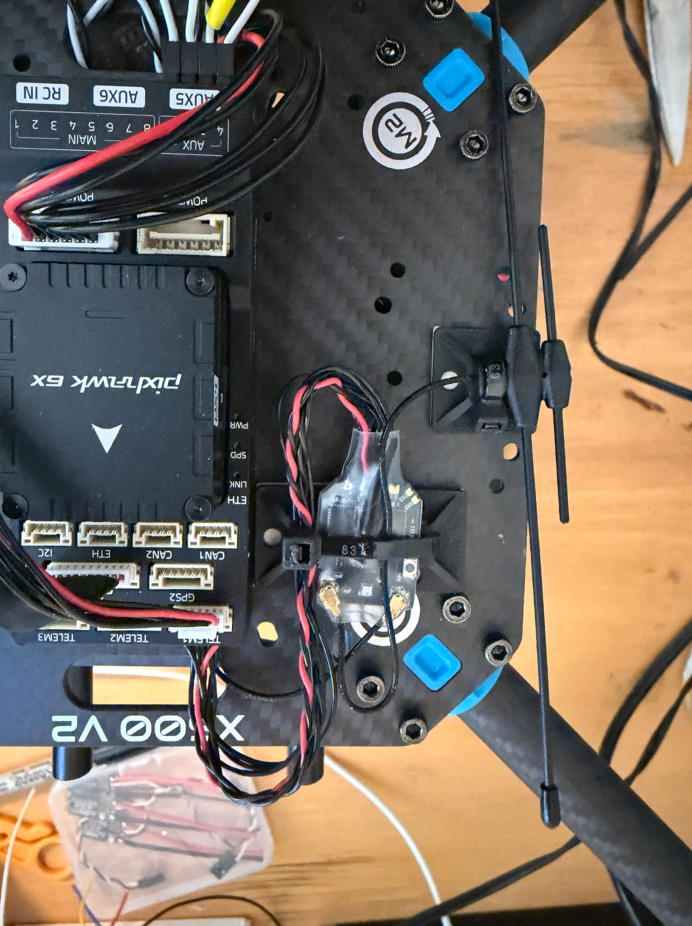
- The receiver (not included in the kit) did not have screw mounting provisions. I thought this was bananas but apparently normal. I encased it in heat shrink and considered hot gluing but ended up using cable tie mounts to make a sort of cradle. See below.
Configuration
Configuration was straightforward, only a couple of minor notes:
- Some parameters are dependent on others and require a reboot to appear after the other has been set
- Setting the airframe to one of the built-in supported frames overwrites ELRS configuration parameters.
- I was concerned that the odd ESC might have too different of performance from the others and I’d have to replace all four. To avoid this as best possible, I followed the ESC calibration procedures and measured the RPM of the motors across the ESC command range and set the ESC parameters so that the RPM matched at the high and low end.
- Flashing updates was surprisingly straightforward although somewhat confusing because of all the things which can be flashed: Handheld Remote, ELRS Transmitter inside the remote, Receiver, Flight Controller. And I’m sure there are others, like the telemetry radios and GPS that I did not get into.
Flight
First flight! I still need to finish studying and take the Part 107 test to fly outside. Since I’m ultimately doing this to participate in DLC 2028, it seemed to fall under the commercial umbrella. I was pretty confident I would crash but I also really wanted to try it out. And, I didn’t crash! Next up: get my Part 107 license and start engineering, building, and testing for the monocopter.